Docker GitHub Builder architecture
Docker GitHub Builder separates repository orchestration from build
implementation. A consuming repository decides when a build runs, which
permissions and secrets are granted, and which inputs are passed. The reusable
workflow in docker/github-builder repository
owns the build implementation itself. That split keeps repository workflows
short while centralizing BuildKit, caching, provenance, SBOM generation,
signing, and multi-platform assembly in one Docker-maintained path.
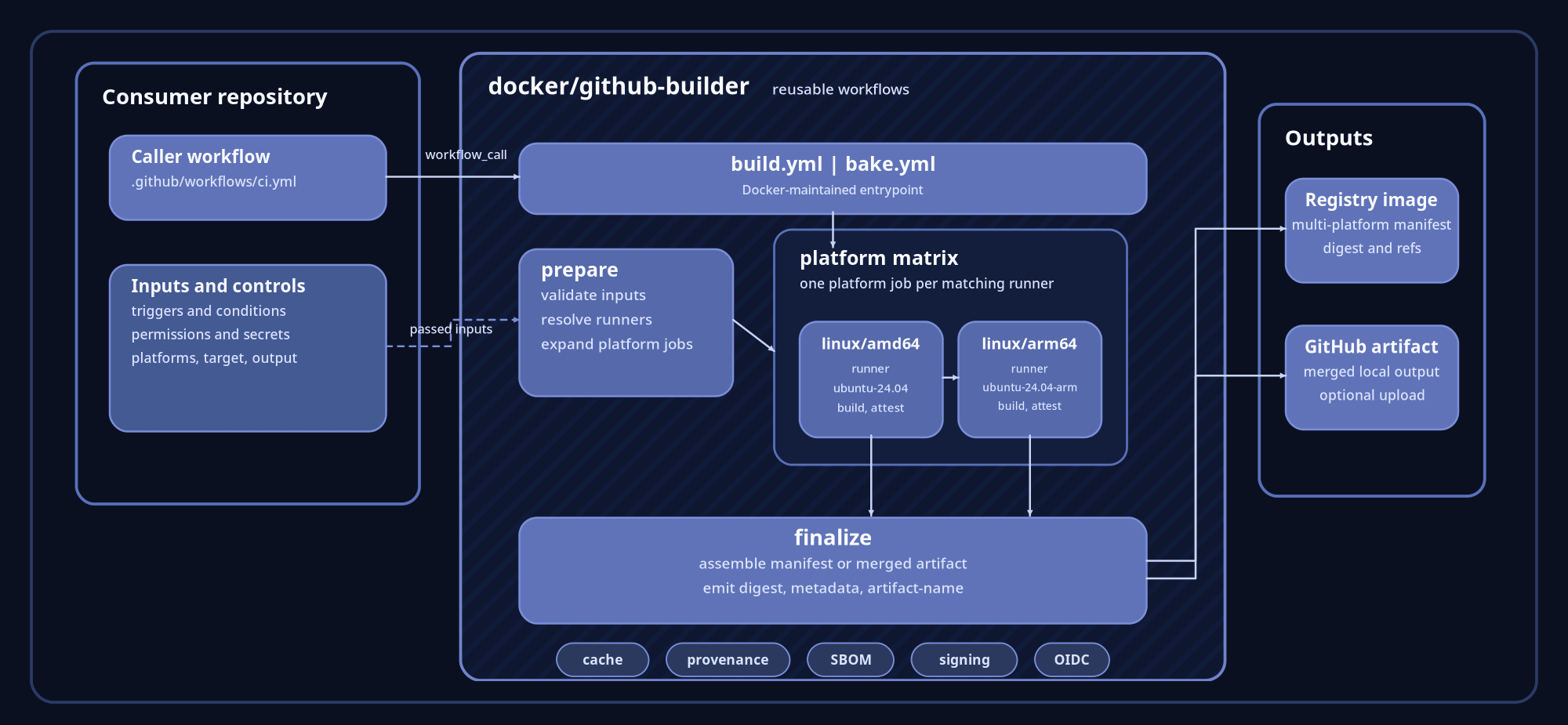
Core architecture
A caller workflow invokes either build.yml or bake.yml.
build.yml is the entrypoint for Dockerfile-oriented builds.
bake.yml is the entrypoint for Bake-oriented builds, where the
Bake definition remains the source of truth for targets and overrides. In both
cases the caller still owns repository policy, including triggers, branch
conditions, permissions, secrets, target selection, metadata inputs, and the
choice between image output and local output.
Inside the reusable workflow, the first phase prepares the build. It validates
the incoming inputs, resolves the appropriate runner, and expands a
multi-platform request into one job per platform. The execution model is
easiest to picture as a matrix where linux/amd64 runs on ubuntu-24.04 and
linux/arm64 runs on ubuntu-24.04-arm. Each platform job builds independently,
then the workflow finalizes the result into one caller-facing output contract.
requested platforms:
  linux/amd64,linux/arm64

conceptual platform jobs:
  linux/amd64 -> ubuntu-24.04
  linux/arm64 -> ubuntu-24.04-arm
Execution path
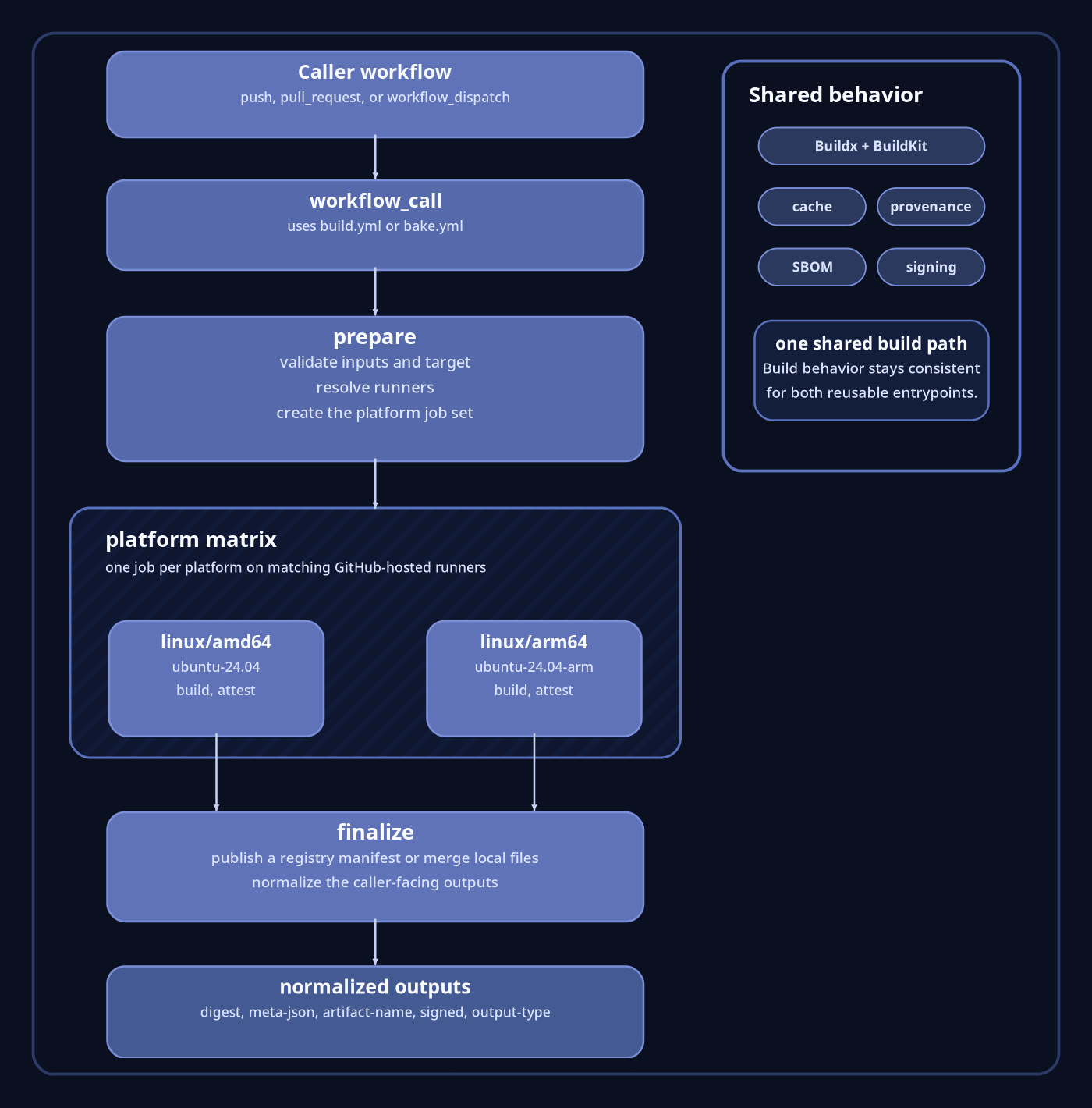
The execution path stays short on purpose. The consuming repository calls the reusable workflow. The reusable workflow prepares the build, runs the per-platform jobs, and finalizes the result. For image output, finalization produces a registry image and multi-platform manifest. For local output, finalization merges the per-platform files and can upload the merged result as a GitHub artifact. The caller does not need to reconstruct how Buildx, BuildKit, caching, or manifest assembly were wired together.
The two reusable entrypoints
build.yml is the better fit when the build is already expressed as
a Dockerfile-oriented workflow. It lines up naturally with concepts such as
context, file, target, build-args, labels, annotations, and
platforms. This is the entrypoint that feels closest to
docker/build-push-action, except the workflow implementation is centralized.
bake.yml is the better fit when the repository already uses Bake
as the build definition. It preserves the Bake model, including target
resolution, files, set, and vars, while still routing execution through
the same Docker-maintained build path. One important architectural detail is
that the Bake workflow is centered on one target per workflow call, which keeps
provenance, digest handling, and final manifest assembly scoped to one build
unit at a time.
Output model
The reusable workflows expose a stable set of caller-facing outputs so
downstream jobs can consume results without understanding the internal job
graph. In practice, the main values are digest, meta-json, artifact-name,
output-type, and signed. That contract matters because it keeps promotion,
publishing, or follow-on automation decoupled from the mechanics of runner
selection and per-platform assembly.
Examples
Dockerfile-oriented image build
The following example shows the shape of a multi-platform image build driven
by build.yml.
name: ci

on:
  push:
    branches:
      - "main"
    tags:
      - "v*"
  pull_request:

permissions:
  contents: read

jobs:
  build:
    uses: docker/github-builder/.github/workflows/build.yml@v1
    permissions:
      contents: read
      id-token: write
    with:
      output: image
      push: ${{ github.event_name != 'pull_request' }}
      platforms: linux/amd64,linux/arm64
      meta-images: name/app
      meta-tags: |
        type=ref,event=branch
        type=ref,event=pr
        type=semver,pattern={{version}}
    secrets:
      registry-auths: |
        - registry: docker.io
          username: ${{ vars.DOCKERHUB_USERNAME }}
          password: ${{ secrets.DOCKERHUB_TOKEN }}
This call is small because the reusable workflow absorbs the heavy lifting. The repository decides when the build should run and which inputs it wants, while the shared implementation handles Buildx setup, BuildKit configuration, platform fan-out, metadata generation, provenance, SBOM generation, signing, and final manifest creation.
Bake-oriented local output
The following example shows the shape of a Bake call that exports local output and uploads the merged artifact.
name: ci

on:
  pull_request:

permissions:
  contents: read

jobs:
  bake:
    uses: docker/github-builder/.github/workflows/bake.yml@v1
    permissions:
      contents: read
      id-token: write
    with:
      output: local
      target: binaries
      artifact-upload: true
      artifact-name: bake-output
This form is useful when the repository already keeps its build definition in Bake and wants to preserve that source of truth. The workflow injects the local output behavior into the Bake run, executes the target per platform when needed, and merges the result into one caller-facing artifact.
Why this architecture works
Performance
The performance story comes from native platform fan-out, shared BuildKit configuration, and centralized cache handling. Multi-platform work can be spread across matching GitHub-hosted runners instead of forcing every architecture through one build machine. That reduces emulation pressure, shortens the critical path for cross-platform builds, and gives every consuming repository the same optimized build baseline.
Security
The security model comes from putting the build implementation in Docker-maintained reusable workflows instead of ad hoc job steps in each consumer repository. The caller still controls permissions and secrets, but the build logic itself is centrally reviewed and versioned. The project also treats provenance, SBOM generation, and signing as first-class concerns, which strengthens the trust boundary between repository orchestration and artifact production.
Isolation and reliability
The reliability story comes from separation of concerns. The consuming repository orchestrates the build. The reusable workflow executes the build. That reduces CI drift, removes repeated glue code from repositories, and makes the outcome easier to reason about because the caller sees a stable contract instead of a large custom job definition.